“Christians who thrive in their relationship with Jesus have discovered their spiritual gifts and are using them to build up Christ’s Body and serve His mission.”

I will be forever grateful for my friend and mentor Dr. Walt Russell. As a seminary student in 1983, Debra and I interned with Walt and his wife “Marty” in Baltimore, Maryland. His love for Jesus, the Church, and Theology was infectious. Walt later became one of the most popular professors at Talbot School of Theology. Sadly, Walt Russell passed away on September 3, 2022. My life and theology have been profoundly impacted through my relationship with Walt and his writing ministry.
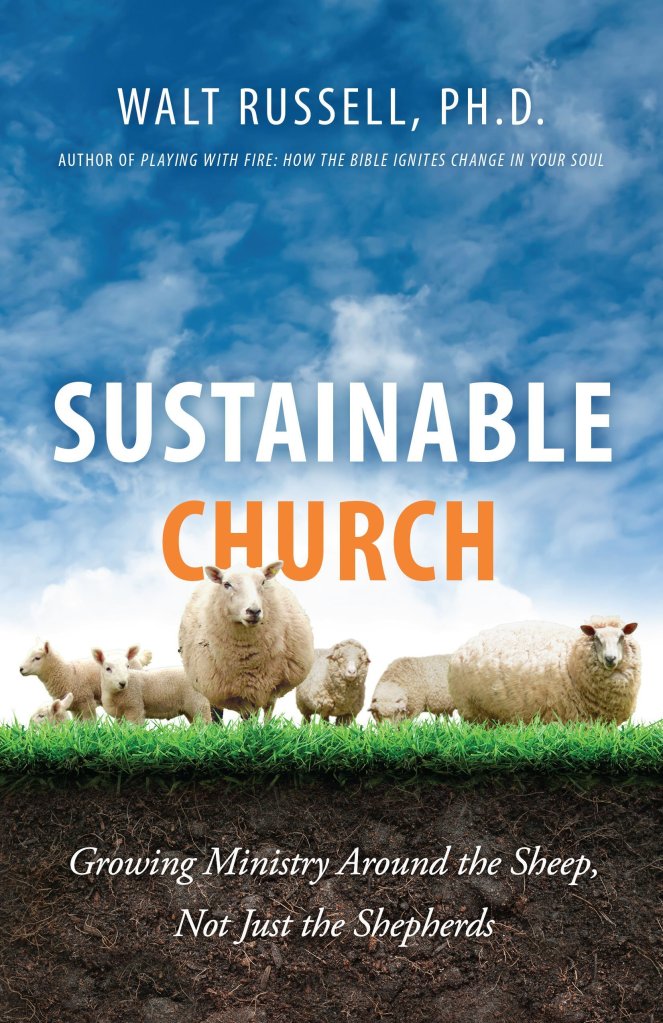
One area of Walt’s passion was equipping believers for ministry to build up and strengthen the Church. His book, Sustainable Church, is a rich source of provocative and refreshing ideas on the importance of growing ministry around the sheep and not the shepherds. Dr. Russell stresses that one of the central needs in equipping believers for service is to help them understand, identify, and practice their own spiritual gifting.
Much of what follows below was developed by Dr. Russsell. I am especially grateful for his summary of the spiritual gifts and the online “Grace Gifts Inventory” that is a tool to assist believers in the identifying of their own gifts.
I recommend the following – use the link below to take the online Grace Gifts Inventory. It will only take a few minutes and the results of your inventory will be emailed to the email address you provide. Once you can see where your personal gifts might be, use the gift descriptions and resources below to assist in your growing understanding and exercise of your spiritual gifts.
Use this link to take Dr. Russell’s “Grace Gifts” Inventory
Reflections On Spiritual Gifts by Tracy Weaver
Key Passages
Romans 12:6-8
What gifts are identified in this passage?
Prophesying, Ministering/Serving, Teaching, Exhorting, Giving, Ruling/Leading, Showing Mercy.
Who is Paul writing to?
Paul is addressing the believers in Rome. “To all those in Rome who are loved by God and called to be saints: Grace to you and peace from God our Father and the Lord Jesus Christ” (Rom 1:7 ESV).
Who is Paul addressing in the context where he mentions “gifts”?
Believers in Christ continue to be the exclusive focus of Paul’s instruction in Romans 12. He calls them “brothers” (v.1) who are to “present your bodies as a living sacrifice” as an act of “spiritual worship.” He continues to clarify his audience by identifying them as “members” of “one body in Christ” and “individually members of one another” (v.5). He then connects his audience to his exhortation – “Having gifts that differ according to the grace given to us, let us use them …” The confident conclusion, therefore, based on the text is that the possessors and users of the “gifts” described in Romans 12 are Christians.
Who does Paul identify as the gift giver?
There is not a direct statement regarding the giver of the gifts but there are two strong inferences. First, in 12:3, Paul exhorts the believers to think of themselves with sober judgment, “each according to the measure of faith that God has assigned.” Paul then states in 12:6 that believers have differing gifts, “according to the grace given to us.” As Paul then illustrates the use of the different gifts, he says, “If prophecy, in proportion to our faith (v.6).” The fact that God (the Father) has assigned each believer a “measure of faith” and faith is then an essential element in the exercise of the gift of prophecy, it would be reasonable to see the Father as the giver of the grace gifts. A second consideration is Paul’s metaphor of one body, many members (v.6). Believers, though many, are “one body in Christ.” It is solely on the basis of being a member of the Body of Christ that an individual can possess a grace gift. Understanding this, it is reasonable to view Jesus as the gift giver. Overall, it would be appropriate to say that the “giver” is not stressed in this passage but rather “the exercise” of the gifts given to members of the Body of Christ.
What is the purpose of the gifts?
While a definitive purpose statement regarding spiritual gifts is not provided in this passage, the overall intent of Paul’s instructions are for the health and vitality of the Body of Christ. Paul stresses that the many members in a human body do not all have the same function (v.4). Through this metaphor Paul is highlighting both the variety of gifts given to the members of Christ’s Body and the needed functioning of the various gifts in the Body of Christ for its health and vitality.
Ephesians 4:11
What gifts are identified in this passage?
Apostles, prophets, evangelists, shepherds, teachers. (Because of the sentence structure some see shepherds and teachers as representing only one gift of Pastor-teacher.)
Who is Paul writing to?
“To the saints who are in Ephesus” (Eph. 1:1). As with the majority of Paul’s epistles, he is writing to the collective Body of Christ in the city. In this case, the metropolitan city of Ephesus.
Who is Paul addressing in the context where he mentions “gifts”?
The letter to the Ephesians is a profoundly significant treatment of the believer’s spiritual life. The target audience throughout Ephesians are those who have been spiritually raised from the dead in Christ Jesus through faith in him (2:5,6,8). After laying a remarkable theological foundation for our life in Christ (chapters 1-3), Paul then turns his attention to the practical outworking of our faith in our behavior (chapters 4-6). The manner of our walk should be worthy of all that God has accomplished on our behalf (4:1). It is in this context that Paul writes, “But grace was given to each one of us (believers), according to the measure of Christ’s gift” (4:7). Note the similar language from Romans 12 – “according to the measure of faith that God has assigned (12:3) … according to the grace given to us (12:6).
Who does Paul identify as the gift giver?
The theology of “gift” is rich in Ephesians. Salvation is the ultimate gift! “For by grace you have been saved through faith. And this is not your own doing; it is the gift of God, not a result of works, so that no one may boast” (Eph. 2:8-9). Paul affirms that his ministry assignment was indeed a gift – “Of this gospel I was made a minister according to the gift of God’s grace, which was given me by the working of his power” (Eph. 3:7). After stressing the oneness and unity of our faith and relationships (one body, one spirit, one hope, one Lord, one faith, one baptism, one God and Father of all – Eph. 4:3-6), Paul turns his attention to the “grace” given “to each one of us.” By referring to Psalm 68:18 (in Eph. 4:8), Paul identifies Jesus as the victorious One who ascends on high, but instead of “receiving gifts among men” (Ps. 68:18), Jesus becomes the giver (Eph. 4:11). “And he gave the apostles, the prophets, the evangelists, the shepherds and teachers (Eph. 4:11 ESV). Christ’s victorious ascension “far above all the heavens” (Eph. 4:10; cf. 1:22-23) makes possible the giving of gifted servants to the Body of Christ.
What is the purpose of the gifts?
Ephesians provides a clear purpose statement for the giving of gifted people to the Body of Christ – “to equip the saints for the work of ministry, for building up the body of Christ” (Eph. 4:12). Earlier we are told that each individual believer is God’s “workmanship, created in Christ Jesus for good works, which God prepared beforehand, that we should walk in them (Eph. 2:10). Gifted men and women are given to the Body of Christ to equip the saints to walk in the good works that God has prepared for them. The proper functioning of the gifts will result in building up of the Body. Paul writes that when each part is working properly it “makes the body grow so that it builds itself up in love” (Eph. 4:16).
For Reflection: Paul identifies that his ministry was “the gift of God’s grace, which was given me by the working of his power” (Eph. 3:7). In Acts 9, however, the “Lord” speaks to Ananias regarding Paul (Saul), telling Ananias, “he is a chosen instrument of mine to carry my name before the Gentiles and kings and the children of Israel” (Acts 9:15). When Ananias finds Paul, he declares to him “Brother Saul, the Lord Jesus who appeared to you on the road by which you came has sent me” (Acts 19:17). In Acts 13 it is the Holy Spirit who says, “Set apart for me Barnabas and Saul for the work to which I have called them (Acts 13:2). Question: Was Paul’s ministry “a gift of God’s (the Father) grace” (Eph. 3:7), was he chosen by “the Lord Jesus” (Acts 9:15) or called by “the Holy Spirit” (Acts 13:2)? The beautiful reality is that the triune God is intimately and harmoniously at work in accomplishing our salvation, calling us to himself, and empowering our service for his glory
1 Peter 4:10-11
What gifts are identified in this passage?
Speaking, Ministering/Serving
Who is Peter writing to?
Peter is writing to believers (elect exiles) who because of persecution and hardship have been dispersed throughout Pontus, Galatia, Cappadocia, Asia, and Bithynia (1:1)
Who is Peter addressing in the context where he mentions “gifts”?
With the theme of suffering hardship woven throughout 1Peter, he encourages the exiled believers to endure, reminding them that the end of all things is at hand (1 Peter 4:7). Peter writes, “Above all, keep loving one another earnestly, since love covers a multitude of sins. Show hospitality to one another without grumbling. As each has received a gift, use it to serve one another as good stewards of God’s varied grace” (1 Peter 4:8-10).
Who does Peter identify as the gift giver?
The believers are instructed to be good stewards of God’s “varied grace”. The implication is that God is the giver and that, as receivers of his gift, believers are to be good stewards of the gift that has been entrusted to them. The gift is to be used as a means to serve one another.
What is the purpose of the gifts?
With the phrase “Above all” (4:8), Peter places what follows as being of supreme importance. What follows is an exhortation to love one another earnestly through the employment of the gifts that God has given, as an act of service toward one another (4:10). In this context, then, the use of spiritual gifts as an act of service becomes a profound expression of love. The ultimate purpose of our rightly using the gifts we have been entrusted with is that “in everything God may be glorified through Jesus Christ” (1 Peter 4:11).
1 Corinthians 12:6-10 / 12:28 / 12:29-30 / 13:1-3 / 13:8 / 14:6 / 14:26
What gifts are identified in this passage?
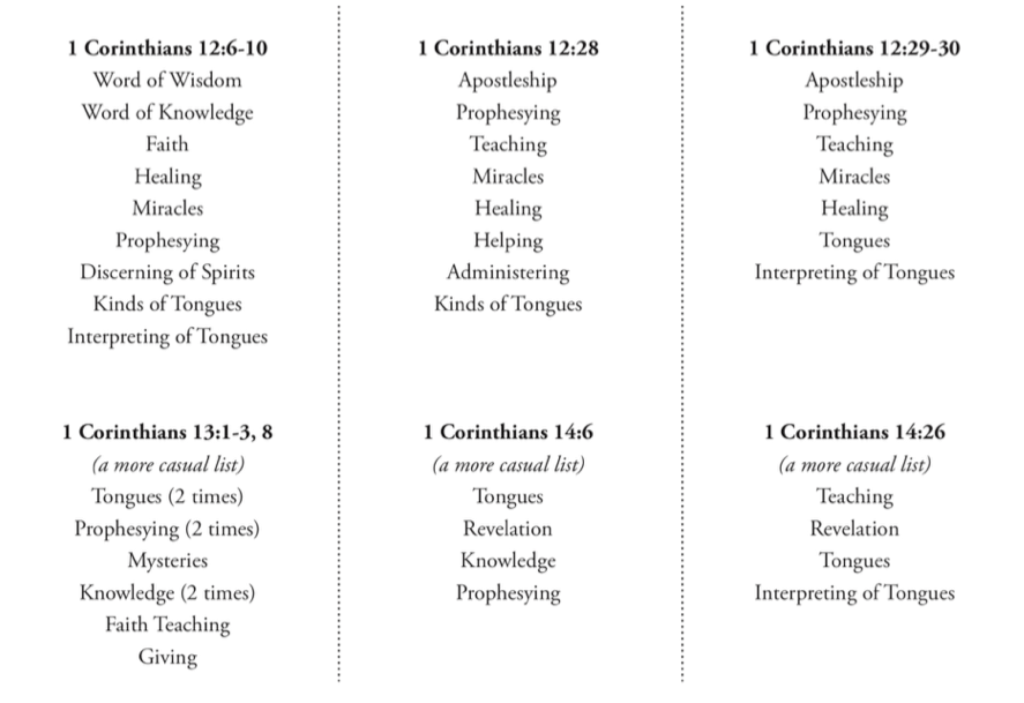
Who is Paul writing to?
“To the church of God that is in Corinth, to those sanctified in Christ Jesus, called to be saints together with all those who in every place call upon the name of our Lord Jesus Christ, both their Lord and ours” (1 Corinthians 1:2). Paul’s letters to the Corinthians stress the inclusive and unified nature of the Body of Christ. Paul is clearly writing to the believers in Corinth but he adds “together with all those who in every place call upon the name of our Lord Jesus Christ, both their Lord and ours.” Paul’s intentional embrace of the broader Body of Christ reveals that he intended his writing to be read and obeyed by more than the original recipients.
Who is Paul addressing in the context where he mentions “gifts”?
“Now concerning spiritual gifts, brothers …” (12:1). As Paul methodically makes his way through a variety of issues concerning the health of the Church at Corinth, he regularly stresses the family nature of the Church by addressing his readers as brothers (28x’s).
In verse 1 of chapter 12, Paul introduces the topic in a wide fashion by using the term pneumatikos, or spiritual things – “Now concerning spiritual things, brothers.” He returns to the more familiar term charismaton or grace gift in verse 4.
Who does Paul identify as the gift giver?
Paul’s most detailed treatment of spiritual gifts is here in 1 Corinthians 12. He provides the most concise definition of a spiritual gift as well as making some interesting statements regarding their source and empowerment.
Concise Definition: “To each is given the manifestation of the Spirit for the common good” (1 Cor. 12:7). This definition reveals three key truths. 1) Every believer has at least one spiritual gift (To each is given). 2) At its core, a spiritual gift is a manifestation (or expression) of the Holy Spirit in the life of the saved individual. 3) The purpose of the spiritual gift is for “the common good”, primarily in the context of the Body of Christ.
Source and Empowerment: Paul writes, “Now there are varieties (diversity) of gifts (charismatōn), but the same Spirit; and there are varieties (diversity) of service (diakoniōn), but the same Lord; and there are varieties (diversity) of activities (energēmatōn – energy, working, operation), but it is the same God who empowers them all in everyone” (1 Cor. 12:4-6). In this statement, Paul stresses the broad spectrum of spiritual gifts, the multiple applications they can have in service, and variety of outcomes that can result. Regardless of the wonderful diversity in the realm of spiritual gifts, however, “it is the same God who empowers them all in everyone” (12:6). It is a general principle that when θεὸς (Theos) is used alone, it is referring to the Father. Paul pulls back the curtain and reveals that it is the Father who empowers every spiritual gift in every believer. Perhaps to be more accurate, because of the close mention of “Spirit” and “Lord” in the immediate context, it would be better to say that it is the Triune God who gives and empowers each gift to every believer.
But Paul isn’t finished. After listing a variety of spiritual gifts in verses 8-10, Paul then makes another amazing statement. “All these are empowered by one and the same Spirit who apportions to each one individually as he wills” (12:11). All the spiritual gifts are empowered by the Holy Spirit and they are “apportioned” to each believer “as he wills.” Lets put those two key passages next to each other.
“it is the same God (θεὸς) who empowers them all in everyone” (12:6)
All these are empowered by one and the same Spirit (πνεῦμα) who apportions to each one individually as he wills” (12:11)
A deep truth to be learned, here, is that the triune God, Father-Son-Holy Spirit, are each and always, personally and intimately, involved in the assigning, distribution, and empowerment of every spiritual gift in every believer. Paul’s theology was not one of isolating the unique contribution of each member of the Godhead in relation to “gifts”, but rather, as is consistent with the rest of his theology, Paul stressed the unified activity of the triune God in empowering the believer for life and service.
What is the purpose of the gifts?
“To each is given the manifestation of the Spirit for the common good” (1 Cor. 12:7).
An Observation Regarding The History of Theology – Are their unique gifts from each person of the Godhead? Our primary source of revelation of the ministry of the Holy Spirit and Spiritual Gifts in the Church Age is the Apostle Paul. Paul wrote letters (epistles) to various City Churches in order to encourage their faith and address various problems they were experiencing. Paul’s letters were read aloud in gatherings of believers. They were carefully copied and circulated among other communities of Christians. During the first 100 years of the Church, however, the average believer would have minimal accessibility to what we now call the New Testament. A person’s primary exposure to inspired New Testament / New Covenant truth would be through the public reading of circulated documents and the oral instruction of teachers. For many believers, their understanding of Spiritual Gifts and the Holy Spirit would have come almost exclusively from the one or two letters sent to their community (e.g. Rome, Corinth, or Ephesus). With regard to the idea of a finely tuned distinction between the gifts of the Father, the gifts of the Son, and the gifts of the Spirit, as some have suggested, it is doubtful that Paul would have left such a unique concept to be pieced together through the investigative ingenuity of the Church over time. Centuries would pass before this “packaging” of Spiritual gifts could be crafted. Rather, Paul’s writing style reveals a pattern of core truths that he wanted the Body of Christ to grasp and walk in. These core truths include the multitude of spiritual realities that are ours by virtue of being “in Christ” through faith in him; the role of the resurrection in securing and empowering our Christian life; the triune activity of God in initiating, accomplishing, and applying salvation to the believer, the unified nature and witness of the Body of Christ to influence the world with the gospel, and the role of spiritual gifts from the triune God for the purpose of building up and equipping the Body of Christ to fulfill its calling.
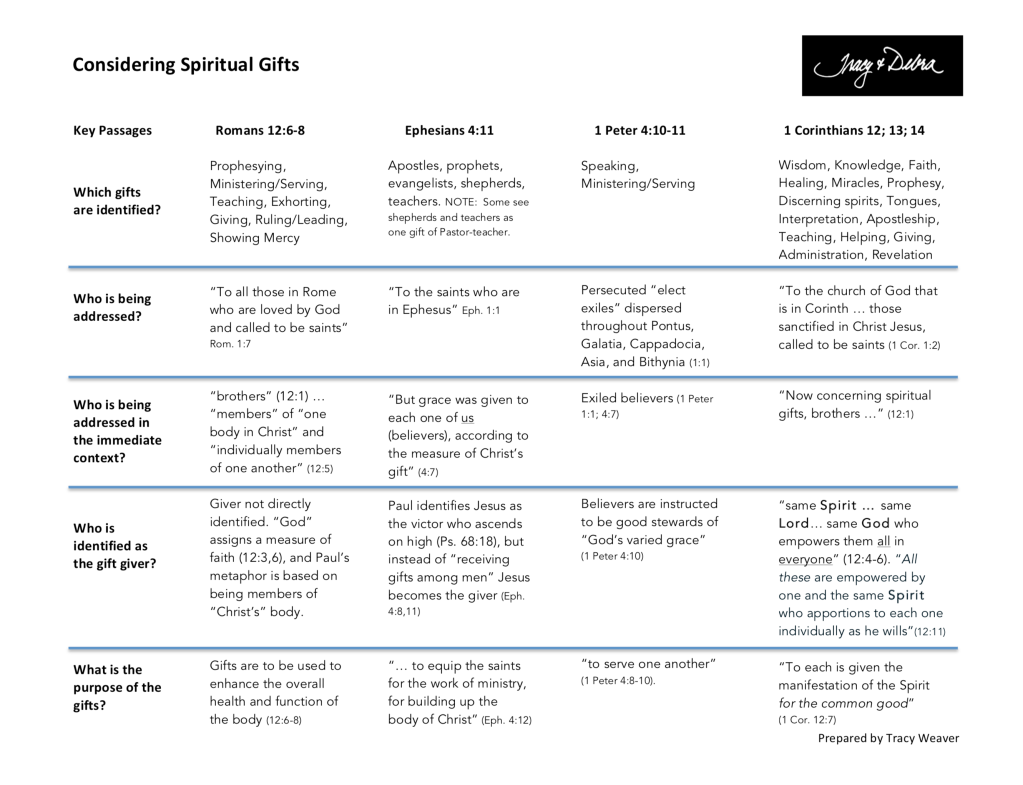
The following chart summarizes the Spiritual Gift discussion above.
Additional Resource: The following link allows you to download Dr. Walt Russell’s very helpful Summary Description of each of the gifts. This tool can be very helpful as you seek to discern your own unique gifting. Spiritual Gifts Summary
 Tracy and Debra